
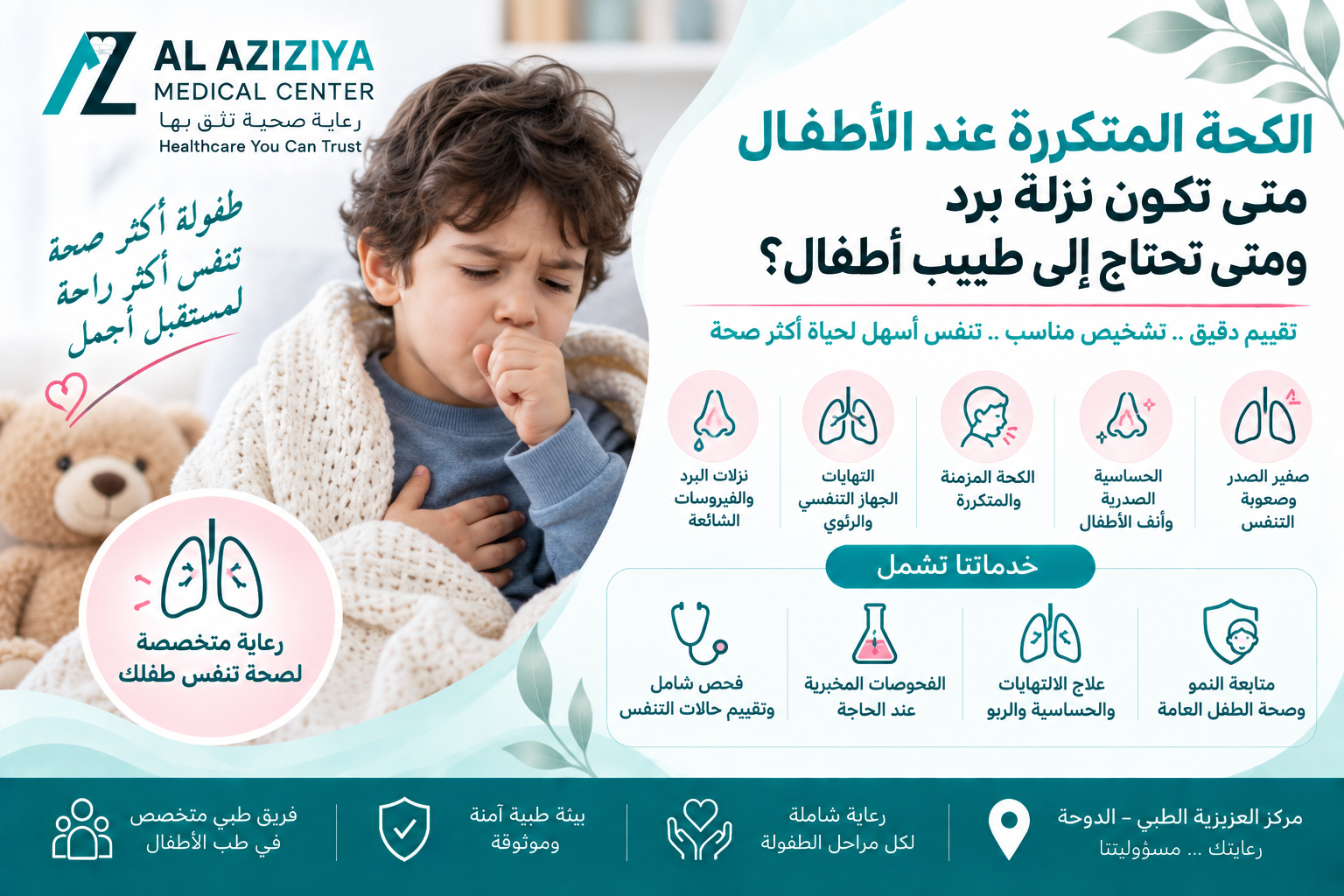
Recurrent Cough in Children in Doha: When Is It a Cold and When Does It Need Pediatric Assessment?
Learn about recurrent cough in children, including colds, allergies, asthma and respiratory infections, and when persistent cough or breathing difficulty needs medical assessment.
Cough is one of the most common symptoms in children and may occur with simple viral colds, allergies, or respiratory infections. In many cases, coughing is a normal protective reflex that helps clear mucus and irritants from the airways, so the presence of a cough alone does not necessarily indicate a serious illness.
However, recurrent coughing, a cough that persists for a prolonged period, or coughing associated with difficulty breathing, wheezing, significant fever, or a clear change in the child's condition may require medical assessment.
Parents should consider the child's overall condition, including breathing, ability to eat and drink, activity level, sleep, and other accompanying symptoms.
Why Do Children Cough So Often?
Children are exposed to many respiratory viruses, particularly when attending nursery, school, or spending time with other children. They may therefore experience repeated colds during the year, often accompanied by a runny nose, sore throat, congestion, and cough.
Cough can also occur with allergies, asthma, airway irritation, and respiratory infections that may require a different approach to assessment and treatment.
Is Coughing Normal With a Common Cold?
Yes. Cough commonly accompanies viral colds because of airway irritation and mucus draining from the nose toward the throat.
If a child is breathing comfortably, eating and drinking reasonably well, remains relatively active, and has no warning signs, the cough often improves gradually as the infection resolves.
Cough can sometimes continue after other cold symptoms have improved because the airways may take additional time to settle.
How Long Can a Child's Cough Last?
Most coughs associated with viral respiratory infections improve gradually, although some can continue for several weeks after an infection.
A persistent daily cough lasting more than four weeks is considered chronic cough in children and should be assessed, particularly when it is not improving.
A near-daily cough between respiratory infections or unusually frequent episodes may also require a different evaluation from a temporary cough caused by a viral illness.
Does Yellow or Green Mucus Mean a Bacterial Infection?
No. Nasal mucus can become yellow or green during a viral cold, and this change alone does not mean that a child needs antibiotics.
The decision to use an antibiotic depends on clinical assessment and evidence of a bacterial infection because antibiotics do not treat the viruses responsible for most common colds.
When Could Cough Be Related to Allergies?
Allergy may be considered when coughing occurs repeatedly with sneezing, itchy nose, prolonged nasal discharge, or symptoms triggered by dust, weather changes, or other environmental exposures.
Because allergy symptoms can overlap with viral cold symptoms, medical assessment may be useful when the pattern is recurrent, persistent, or affecting sleep and daily activities.
When Could Cough Be Related to Asthma?
Asthma may be considered when cough occurs together with wheezing or shortness of breath or repeatedly appears at night, during exercise, or with specific triggers.
Not every nighttime cough is caused by asthma. The pattern of symptoms, frequency, examination, and personal and family history all help guide evaluation.
What Is the Difference Between Bronchitis and Pneumonia?
Bronchitis affects the airways and can cause cough, mucus, and sometimes wheezing. Pneumonia affects the lung tissue itself and may be associated with fever, tiredness, rapid breathing, or difficulty breathing.
Parents cannot reliably distinguish these conditions from the sound of the cough alone. Medical assessment becomes important when the child appears unwell or breathing becomes faster or more difficult.
When Is Difficulty Breathing a Warning Sign?
Prompt medical assessment is needed when a child is clearly working harder to breathe, when the ribs or skin under the ribs pull inward during breathing, or when breathing becomes unusually fast or noisy.
If the child cannot speak, cry, feed, or eat normally because of breathing difficulty, or if the lips or face become blue, grey, or unusually pale, emergency medical care is needed.
Does Fever With a Cough Require Medical Assessment?
Fever is common with many viral infections, but the child's age, temperature, duration of fever, and overall condition all matter.
Medical assessment is appropriate when fever persists, returns after the child had begun to improve, or is associated with significant lethargy or poor fluid intake.
Fever in very young infants requires more prompt assessment according to the infant's age and temperature.
What About Cough in Infants?
Infants require closer observation because rapid or labored breathing can interfere with feeding.
Nasal congestion can also make feeding and sleeping more difficult.
Urgent medical assessment is needed if an infant feeds much less than usual, breathes rapidly or with significant effort, has pauses in breathing, or becomes unusually sleepy or difficult to wake.
Are Cough and Cold Medicines Suitable for Every Child?
Cough and cold medicines should not be given randomly to young children. Some products are not appropriate for certain ages and may contain several active ingredients.
Parents should ask a doctor or pharmacist before using these products and check the ingredients carefully to avoid giving the same medication through more than one product.
Can Honey Help Soothe a Cough?
A small amount of honey may help soothe cough in children aged 12 months or older.
Honey must not be given to infants younger than 12 months because of the risk of infant botulism.
What Can Be Done at Home?
Appropriate fluid intake and rest can support recovery from many uncomplicated viral respiratory infections.
Gentle nasal clearing using age-appropriate methods may also help when congestion interferes with feeding or sleep.
Children should be kept away from cigarette smoke, vaping, and other strong airway irritants, and parents should monitor breathing and overall condition rather than focusing only on how often the child coughs.
Do Antibiotics Stop a Cough?
Antibiotics treat selected bacterial infections but do not treat the viruses responsible for most common colds and acute cough illnesses in children.
They should therefore not be used without appropriate medical assessment, and yellow or green nasal mucus alone does not mean that antibiotics are required.
When an antibiotic is prescribed for a bacterial infection, it should be used according to the instructions provided for that condition.
When Does Recurrent Cough Need Additional Testing?
A doctor may consider additional investigations when a child has a persistent daily cough lasting more than four weeks, recurrent wheezing or breathing difficulty, or an unusually frequent pattern of cough.
Testing may also be considered when there is poor growth, repeated infections, chronic wet cough, or other features suggesting an underlying condition.
Not every child with a cough needs blood tests or imaging. Investigations are selected according to cough duration, whether the cough is wet or dry, examination findings, medical history, and associated symptoms.
When Is an Earlier Medical Visit Better?
An earlier visit is appropriate when cough interferes significantly with sleep or eating, becomes progressively worse, repeatedly returns, or is accompanied by wheezing or rapid breathing.
Children with chronic medical conditions or a history of recurrent respiratory problems may also need earlier review when new symptoms develop.
Respiratory Infection Care at Al Aziziya Medical Center
The Pediatrics Department at Al Aziziya Medical Center in Doha provides healthcare for children from birth through adolescence, including treatment of colds and allergies, growth and development monitoring, and assessment of common childhood illnesses.
The department also provides respiratory infection care for conditions including bronchitis, pneumonia, and other respiratory illnesses.
Evaluation of a child's cough considers age, symptom duration, the nature of the cough, breathing pattern, fever, wheezing, and other findings before treatment or investigations are selected.
Watch the Child's Breathing, Not Just the Sound of the Cough
Cough can be persistent and distressing, but a child's breathing, general condition, ability to eat and drink, and activity level are particularly important indicators.
Difficulty breathing, marked chest retractions, blue lips or face, or severe lethargy require prompt medical attention.
At Al Aziziya Medical Center in Doha, the Pediatrics Department provides assessment for colds, allergies, respiratory infections, and recurrent cough, with follow-up and treatment selected according to the child's age, symptoms, and health needs.