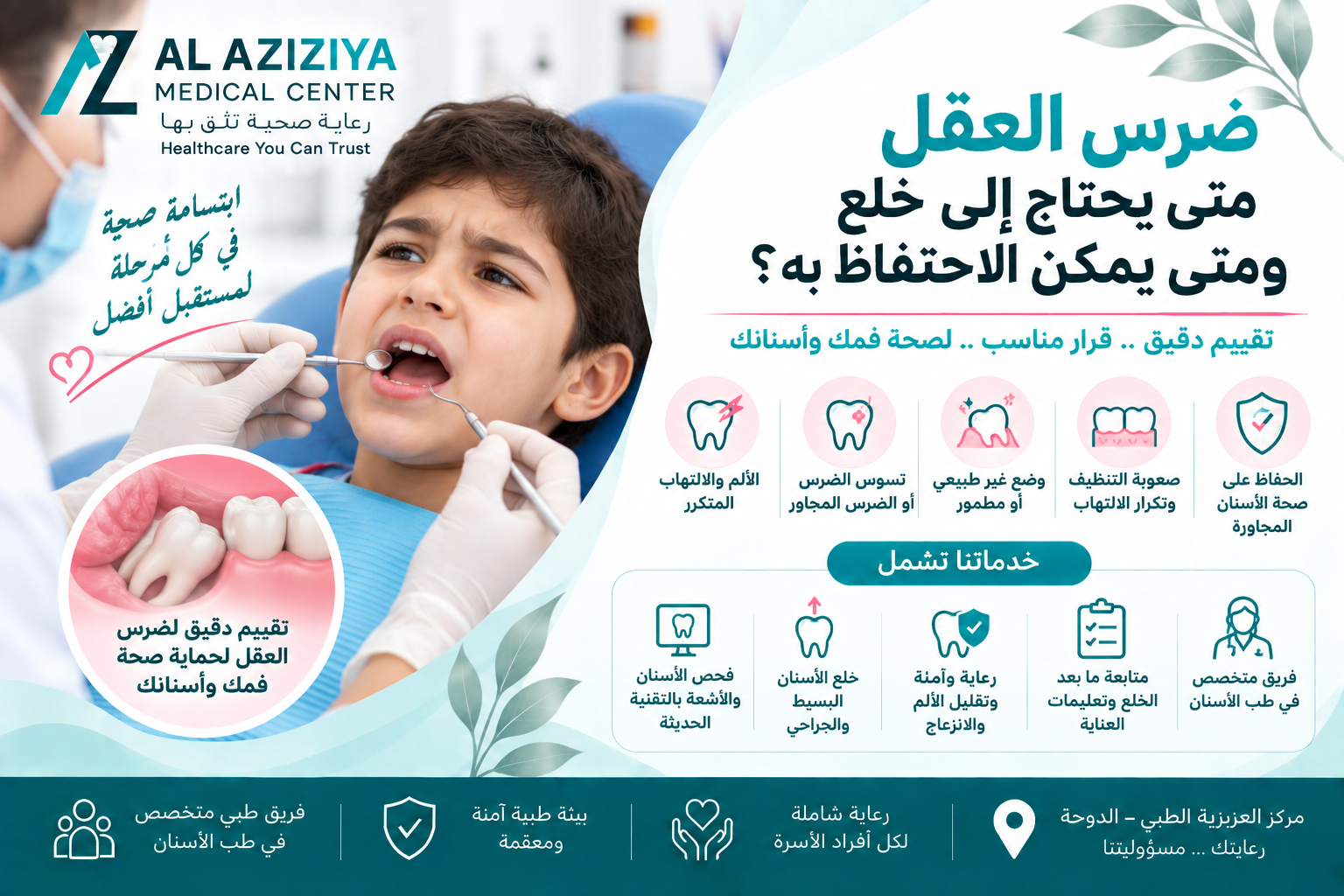
Wisdom Teeth in Doha: When Do They Need Removal and When Can They Be Kept?
Learn when wisdom teeth may need removal, when they can be safely monitored, the difference between simple and surgical extraction, and important aftercare following removal.
Wisdom teeth are the last permanent teeth to develop at the back of the mouth. Some people have wisdom teeth that erupt normally and never cause problems, while others develop pain, recurrent gum inflammation, decay, or difficulty cleaning the area because there is not enough room for the tooth to erupt completely.
The presence of a wisdom tooth does not automatically mean that it must be removed. Management depends on the tooth's position, eruption status, surrounding gum tissue, adjacent teeth, and whether there is decay, infection, or other disease.
A dentist can assess the tooth clinically and may use dental imaging to evaluate its position, roots, and relationship to surrounding structures.
What Is a Wisdom Tooth?
Wisdom teeth, also called third molars, are the teeth located furthest back in the jaws and are usually the last permanent teeth to develop and erupt.
They commonly begin to appear during the late teenage years or early adulthood, although timing varies between individuals.
A wisdom tooth may erupt fully in a normal position, emerge only partially, remain completely beneath the gum or bone, or develop at an angle toward the neighboring tooth.
Do All Wisdom Teeth Need to Be Removed?
No. Not every wisdom tooth needs extraction.
A wisdom tooth that has fully erupted, is functional, can be cleaned adequately, and shows no evidence of decay, gum disease, infection, or damage to neighboring teeth may be retained and monitored during routine dental care.
When disease or recurrent problems develop, the dentist can discuss whether removal is appropriate after considering the benefits and risks.
What Is an Impacted Wisdom Tooth?
An impacted wisdom tooth is unable to erupt normally and completely into the mouth.
It may be partially covered by gum tissue, completely contained within the jawbone, or positioned vertically, diagonally, or horizontally.
Impaction alone does not automatically mean that every tooth requires extraction. Some disease-free impacted wisdom teeth can be monitored according to the clinical situation.
What Are Common Symptoms of Wisdom Tooth Problems?
Possible symptoms include:
- Pain or pressure at the back of the jaw.
- Red or swollen gum tissue around the tooth.
- Pain when chewing.
- Difficulty or discomfort when opening the mouth.
- Food trapping around a partially erupted tooth.
- Unpleasant taste or breath.
- Repeated inflammation around the wisdom tooth.
These symptoms can also result from other dental conditions, so examination is important to identify the source.
Why Does the Gum Around a Wisdom Tooth Become Inflamed?
When only part of the tooth has erupted, a flap of gum tissue may remain over part of the crown. Food debris and plaque can collect in this area because it is difficult to clean.
This may cause inflammation of the tissues surrounding the tooth, known as pericoronitis.
A single mild episode does not necessarily mean that immediate extraction is required, but recurrent or severe episodes may be an indication to discuss removal.
Can Wisdom Teeth Cause Tooth Decay?
Yes. Their position at the very back of the mouth can make wisdom teeth difficult to reach with a toothbrush and floss, particularly when they are angled or partially erupted.
Plaque accumulation can contribute to decay in the wisdom tooth itself or on the neighboring second molar.
The adjacent tooth should therefore also be evaluated when a wisdom tooth is assessed.
Do Wisdom Teeth Cause Crowding of the Front Teeth?
Front-tooth crowding can develop over time for several reasons involving jaw growth, tooth position, and normal age-related dental changes.
Wisdom tooth extraction is therefore not usually recommended solely to prevent or treat anterior crowding without another clinical indication for removal.
If crowding is the main concern, an orthodontic assessment can help determine the cause and appropriate management.
When Might a Wisdom Tooth Need Removal?
Wisdom tooth extraction may be considered when there is a condition related to the tooth, including:
- Recurrent inflammation or infection around the tooth.
- Decay that cannot be appropriately restored.
- Dental abscess or infection.
- Damage or decay involving the neighboring tooth.
- Periodontal disease around the wisdom tooth.
- A cyst or another pathological change associated with the tooth.
- Pain that has been clinically linked to the wisdom tooth.
- Other situations in which the tooth's position is creating a clear dental problem.
The decision should be based on examination and imaging rather than pain alone.
When Can a Wisdom Tooth Be Kept?
A healthy wisdom tooth can often be retained when it is disease-free, functional, cleanable, and can be appropriately monitored.
Retained wisdom teeth require routine dental examinations like other teeth, and periodic imaging may be recommended when part of the tooth cannot be seen directly or its position needs monitoring.
The absence of pain alone does not guarantee that the tooth is healthy.
How Does a Dentist Decide Whether a Wisdom Tooth Needs Removal?
The assessment begins with examination of how much of the tooth has erupted, the health of the surrounding gum, decay, inflammation, and the condition of the neighboring tooth.
Dental imaging may be used to assess:
- The direction of the wisdom tooth.
- The shape and number of roots.
- How much of the tooth remains within bone.
- Its relationship to the neighboring second molar.
- The proximity of lower wisdom tooth roots to nearby nerves.
- The relationship of upper wisdom teeth to the maxillary sinus when relevant.
- Other changes not visible during examination.
The dentist can then discuss the benefits and risks of removal compared with continued monitoring.
Are X-Rays Needed Before Wisdom Tooth Removal?
Dental imaging is useful in many wisdom tooth cases, particularly for impacted or partially erupted teeth.
It can help identify root anatomy, tooth angulation, bone position, nearby teeth, nerves, and other important structures.
The dentist decides which type of imaging is appropriate for the individual case.
What Is the Difference Between Simple and Surgical Extraction?
A fully erupted tooth that can be easily accessed may sometimes be removed by simple extraction under local anesthesia.
An impacted or partially buried wisdom tooth may require surgical extraction, which can involve additional steps to access and remove the tooth.
In some cases the tooth may be divided into smaller sections to facilitate safe removal.
The type of extraction depends on tooth position and imaging findings rather than the severity of pain alone.
Is Wisdom Tooth Removal Painful?
Local anesthesia is used to numb the area during extraction.
Patients may feel pressure or movement during the procedure, but significant sharp pain should be reported so that the anesthesia can be assessed.
After the anesthesia wears off, varying degrees of discomfort and swelling can occur, particularly after more complex surgical removal.
What Happens After Wisdom Tooth Removal?
A blood clot forms inside the extraction socket and plays an important role in healing.
During the first few days, some swelling, soreness, jaw stiffness, or temporary difficulty chewing may occur.
The degree and duration of these symptoms vary according to the complexity of extraction, the tooth involved, and the individual's health.
What Is Dry Socket?
Dry socket is a painful complication that can occur when the blood clot in the extraction socket does not form adequately or is lost before early healing has progressed.
Pain often develops or becomes significantly worse several days after the extraction rather than gradually improving.
This requires dental review so the extraction site can be examined and appropriate care provided.
How Should the Extraction Site Be Cared For?
Patients should follow the specific instructions provided by their dentist because aftercare can vary depending on the procedure.
In general, protecting the blood clot and maintaining oral hygiene without aggressively disturbing the socket are important.
Smoking should be avoided during recovery because it is associated with a higher risk of healing problems, including dry socket.
Aggressive rinsing or unadvised home remedies should also be avoided during the early healing period unless recommended by the treating dentist.
What Can You Eat After Wisdom Tooth Removal?
Soft, easy-to-chew foods are often more comfortable during the first stage of recovery.
Hard, crunchy, or small foods that can enter the extraction site may be better avoided early on.
Normal food consistency can be reintroduced gradually as pain and swelling improve and according to the dentist's advice.
Can You Brush Your Teeth After Extraction?
Yes. Oral hygiene remains important after extraction, but brushing should be gentle and direct trauma to the extraction site should be avoided initially.
The dentist may provide specific instructions about when and how to clean or rinse the area.
The aim is to keep the mouth clean without disturbing the healing clot or wound.
When Can You Return to Work or Normal Activity?
Return to normal activity depends on the complexity of the extraction, the type of work, and the individual's recovery.
Some people can return quickly to light activities, while more difficult surgical extraction may require additional rest.
Strenuous exercise may need to be avoided during the early recovery period because it can increase bleeding or discomfort.
When Should You Contact the Dentist After Extraction?
Dental review is appropriate if pain or swelling is severe or getting worse rather than improving, or if bleeding continues despite following the dentist's instructions.
Increasing pain associated with fever, feeling unwell, or an unpleasant taste or odor may also require assessment.
Difficulty breathing or swallowing or rapidly increasing swelling of the face or neck requires urgent medical care.
Can More Than One Wisdom Tooth Be Removed in One Visit?
More than one wisdom tooth can sometimes be removed during the same appointment, but this is not appropriate for every patient.
The decision depends on the number and position of the teeth, expected surgical difficulty, health status, anesthesia plan, and individual circumstances.
The dentist or surgeon can discuss the expected recovery and the advantages and considerations of each approach.
Why Should Recurrent Wisdom Tooth Inflammation Not Be Ignored?
Repeated inflammation around a wisdom tooth may indicate that its position or the overlying gum tissue makes the area difficult to clean and prone to recurring problems.
Treating the current episode may relieve symptoms, but recurrent inflammation requires evaluation of whether continued monitoring or extraction is more appropriate.
Wisdom Tooth and Dental Extraction at Al Aziziya Medical Center
The Dentistry Department at Al Aziziya Medical Center in Doha provides simple and surgical tooth extraction as part of its dental services.
Assessment begins with examination of the teeth and gums, the cause of symptoms, the wisdom tooth, and the neighboring tooth. Dental imaging may be used when needed to identify tooth angulation, root anatomy, and surrounding structures.
The findings help determine whether the wisdom tooth should be removed or can be retained and monitored, as well as which type of procedure is appropriate.
The Right Decision Starts With Assessment, Not Pain Alone
A wisdom tooth may remain healthy for years and can sometimes be retained when it is disease-free and appropriately monitored. In other cases, extraction may be recommended because of recurrent inflammation, decay, infection, or damage to neighboring teeth or tissues.
There is therefore no rule requiring every wisdom tooth to be removed simply because it has erupted or is impacted.
At Al Aziziya Medical Center in Doha, the Dentistry Department provides assessment of wisdom tooth concerns and simple or surgical tooth extraction, with management selected according to examination, imaging, and each patient's individual condition.