Braces in Doha: When Do You Need Orthodontic Treatment and What Is the Difference Between Metal and Clear Braces?
Learn when orthodontic treatment may be needed, the difference between metal and clear braces, and how crowding, gaps and bite problems are assessed in children and adults.
Orthodontic treatment is not only about improving the appearance of a smile. It can also help correct tooth alignment, crowding, gaps, and certain bite problems. In some cases, irregularly positioned teeth can make cleaning more difficult or allow food and plaque to accumulate, while bite problems may affect chewing or jaw comfort.
When considering orthodontic treatment, several questions commonly arise: Do I really need braces? Are metal or clear braces more suitable? Can adults have orthodontic treatment? How long will follow-up take? The answer differs from one patient to another because the treatment plan depends on tooth position, the relationship between the jaws, the degree of crowding or spacing, and the health of the teeth and gums before treatment begins.
When Do You Need Orthodontic Treatment?
An orthodontist may recommend treatment when there is noticeable dental crowding, gaps between teeth, protruding teeth, or an irregular bite between the upper and lower teeth. Some patients may also need assessment because teeth have tilted or shifted or because their alignment affects the overall appearance of the smile.
The need for orthodontic treatment cannot always be determined simply by looking at the teeth in a mirror. Some problems relate more to the bite or relationship between the jaws than to the visible appearance of individual teeth. Proper assessment therefore begins with a specialist examination.
What Happens at the First Orthodontic Appointment?
During the first visit, the orthodontist examines the teeth, jaws, and bite and discusses what concerns the patient and what they would like to improve. Photographs, X-rays, or measurements may be needed to understand the position of the teeth more accurately and develop a suitable treatment plan.
The orthodontist can then discuss the available options, whether metal or clear orthodontic treatment may be suitable, what follow-up will involve, and whether any dental or gum treatment should be completed before orthodontic treatment begins.
Metal Braces: Why Are They Still a Common Option?
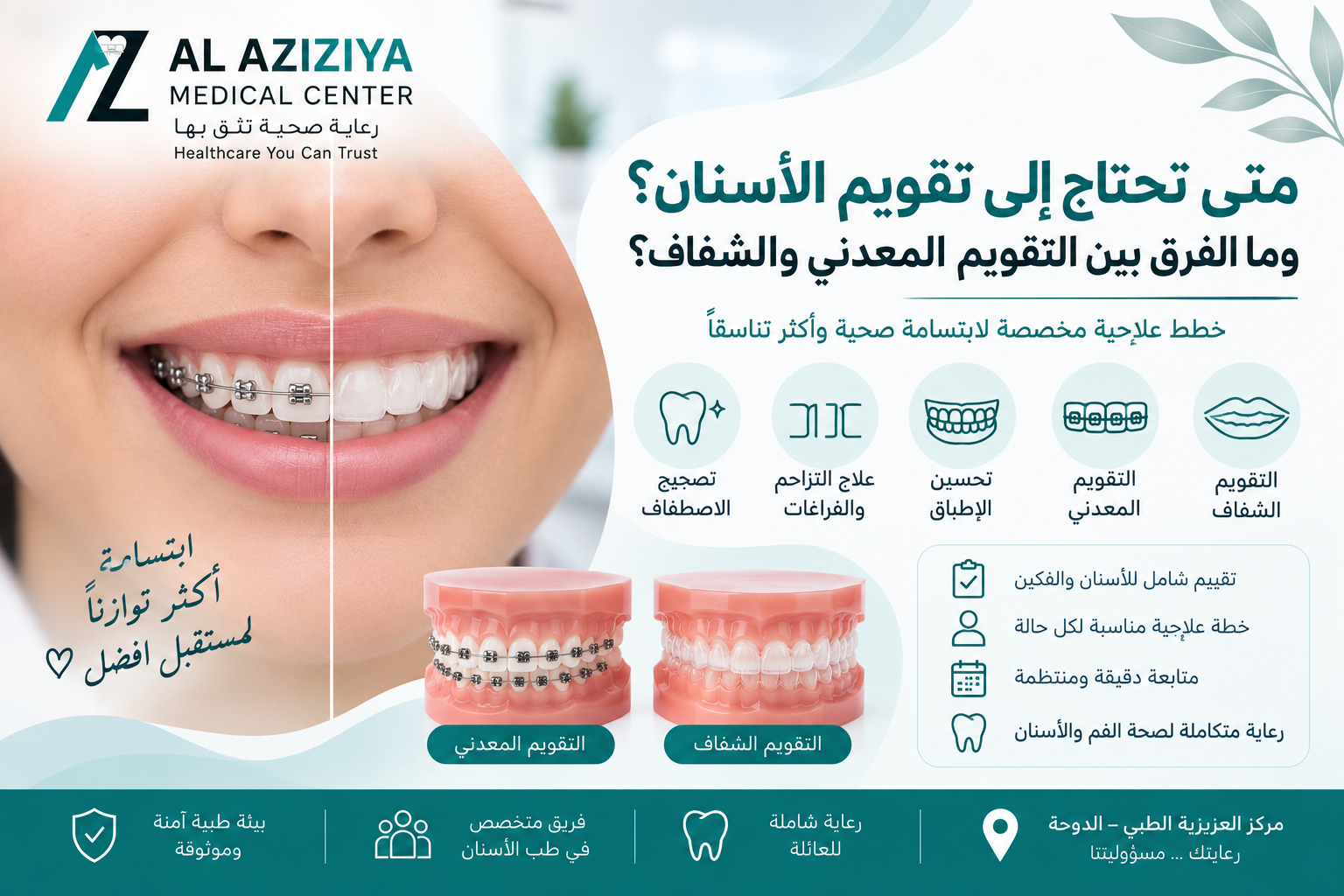
Metal braces use brackets and wires to gradually move the teeth toward their planned positions. They are widely used for many cases involving dental crowding, spacing, and alignment problems.
One advantage is that the orthodontist can control tooth movement throughout the treatment process. Metal braces can be appropriate for a wide range of cases and require periodic appointments for adjustments and monitoring of treatment progress.
What Are Clear Aligners?
Clear orthodontic treatment commonly uses transparent aligners designed to move the teeth gradually according to a planned sequence. Their appearance is less noticeable, and the aligners can usually be removed at specific times such as during meals and tooth brushing according to the orthodontist's instructions.
However, clear aligners are not automatically suitable for every case. The severity of crowding, the types of tooth movements required, and the patient's ability to wear the aligners for the prescribed amount of time all influence treatment success.
What Is the Difference Between Metal Braces and Clear Aligners?
The difference is not only cosmetic. Metal braces remain fixed to the teeth and work continuously, while clear aligners depend significantly on the patient's commitment to wearing them for the daily duration recommended by the orthodontist.
The two approaches may also differ in their ability to manage particular types of tooth movement. There is therefore no rule that one option is better for everyone. The appropriate option is the one that suits the patient's orthodontic condition and can be followed correctly throughout treatment.
Are Braces Suitable for Adults?
Yes. Orthodontic treatment is not limited to children and teenagers. Adults may also benefit from treatment after the health of the teeth and gums has been assessed and any conditions requiring treatment have been addressed first.
Adults may seek orthodontic care to improve crowding, spacing, or bite problems, or to reposition teeth before certain restorative or aesthetic dental procedures. The treatment plan varies according to the individual condition, age, and oral health.
When Might a Child Need an Early Orthodontic Assessment?
Early orthodontic assessment may be useful when parents notice significant crowding, protruding teeth, an unusual relationship between the jaws, or early loss of primary teeth.
An early assessment does not necessarily mean that orthodontic treatment will begin immediately. In some cases, the orthodontist may recommend observation until the most appropriate time for intervention. The aim is to monitor tooth and jaw development and identify problems that may benefit from treatment at a particular stage.
Dental Crowding and Gaps: Are Braces Always the Solution?
Crowding occurs when there is not enough space for teeth to align normally, while spacing refers to noticeable gaps between teeth. Orthodontic treatment is commonly used to improve both conditions, but the treatment plan depends on their cause and severity.
The orthodontist may need to assess tooth size, available space, and the relationship between the jaws before deciding on treatment because similar-looking problems may have different causes in different patients.
What Are Bite Problems?
The bite describes how the upper and lower teeth meet when the mouth closes. When the relationship between the teeth or jaws is not balanced, certain teeth may protrude or fail to meet properly during biting.
Assessing the bite helps determine whether orthodontic treatment alone may be appropriate or whether a different plan is required. Evaluation of the relationship between the teeth and jaws is therefore an important part of orthodontic assessment.
Should Tooth Decay and Gum Problems Be Treated Before Braces?
The teeth and gums should be in suitable condition before orthodontic treatment begins. Active tooth decay or gum inflammation may need to be treated first. Oral hygiene also becomes especially important during treatment, particularly with fixed appliances that require careful cleaning around brackets and wires.
The dentist or orthodontist may therefore recommend professional cleaning or treatment of existing dental problems before braces are placed, together with continued dental checkups during orthodontic treatment.
How Do You Keep Your Teeth Clean During Orthodontic Treatment?
Regular and thorough cleaning is an important part of successful orthodontic treatment. Food debris and plaque should be removed carefully around the orthodontic appliance, and cleaning tools recommended by the dental team can be used when needed.
Poor oral hygiene may increase the risk of tooth decay, gum inflammation, or visible changes on the tooth surface. Daily oral care is therefore an essential part of the treatment plan rather than simply a cosmetic consideration.
Will the Result Last After Braces Are Removed?
After the active tooth-movement stage is completed, many patients require a retention phase to help maintain the new positions of the teeth. The orthodontist determines the appropriate type of retainer and how it should be used.
Following retention instructions is important because teeth can gradually move over time, particularly during the period immediately after orthodontic appliances are removed.
Dr. Hossam Saadi Othman at Al Aziziya Medical Center
Dr. Hossam Saadi Othman, Orthodontics Specialist at Al Aziziya Medical Center in Doha, provides orthodontic assessment and treatment for tooth alignment and bite concerns in children and adults.
His care includes orthodontic treatment options selected according to each case, management of crowding and spacing, correction of alignment and bite concerns, regular follow-up, and individualized orthodontic treatment planning.
Orthodontics at Al Aziziya Medical Center Dental Department
The Dental Department at Al Aziziya Medical Center provides a range of preventive, restorative, and aesthetic dental services, including orthodontic care. Having different dental services available within the same department supports evaluation of tooth and gum health and treatment of dental problems that may need attention before or during orthodontic care.
Orthodontic treatment begins with assessment rather than simply choosing between metal and clear appliances. A balanced treatment result depends on understanding tooth position and the bite, selecting the appropriate approach, and following progress regularly.
The First Step Is the Right Assessment
Successful orthodontic treatment does not begin with choosing metal or clear braces. It begins with an accurate diagnosis and a treatment plan based on tooth position, the jaws, oral health, and the individual patient's needs. What suits one person may not be the appropriate option for another.
At Al Aziziya Medical Center in Doha, the Dental Department provides orthodontic services for children and adults, including treatment of dental crowding, spacing, and bite concerns with regular follow-up throughout the orthodontic journey.