
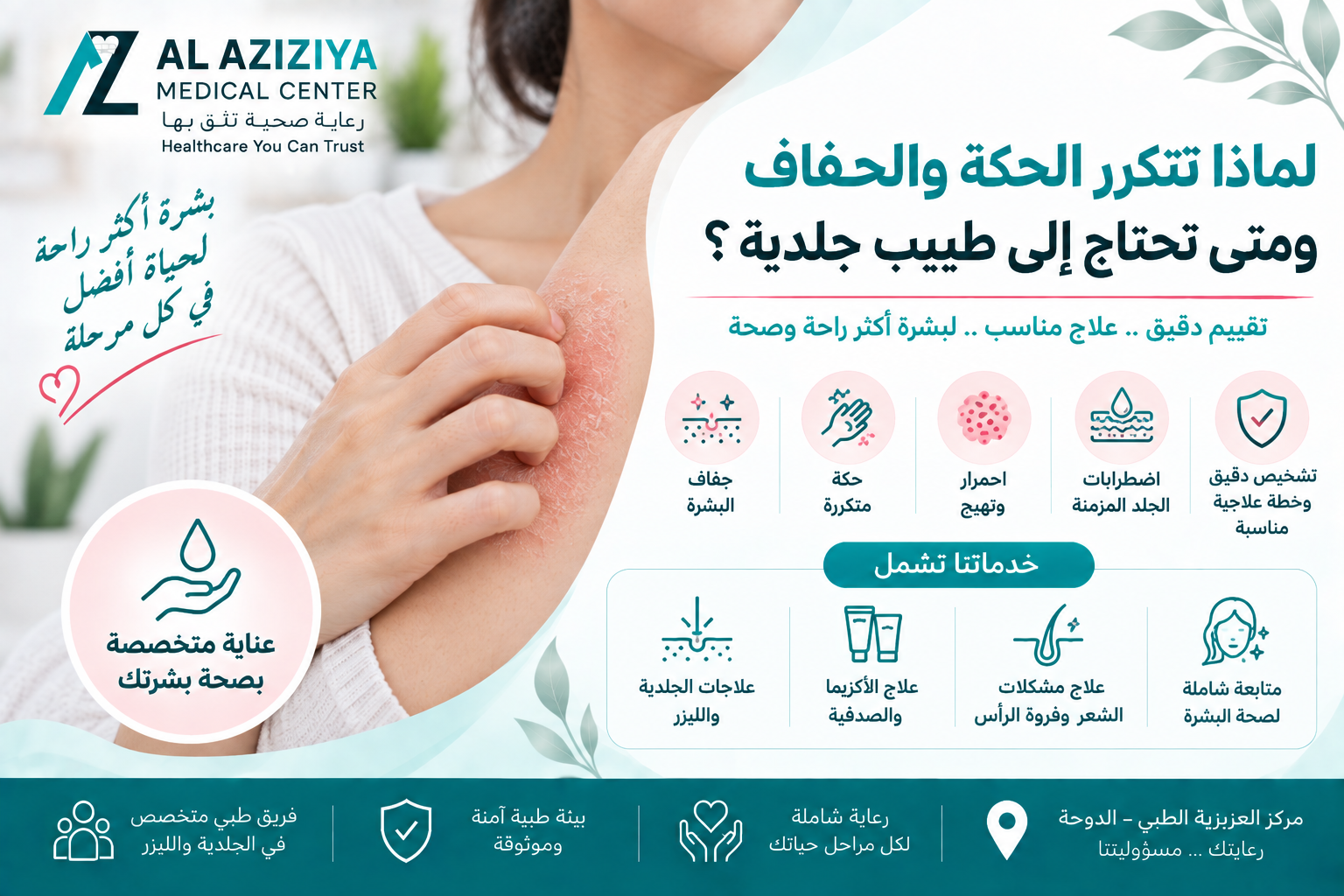
Eczema and Dry Skin in Doha: Why Does Itching Keep Returning and When Should You See a Dermatologist?
Learn the difference between eczema and dry skin, why itching and redness can recur, common triggers, daily skin care, and when dermatology assessment may be needed.
Itching, dryness, and redness may initially seem like minor skin concerns, but repeated symptoms in the same areas or recurring flare-ups can sometimes indicate an inflammatory skin condition such as eczema.
Eczema is not contagious and cannot be passed from one person to another through touching or normal contact. However, affected skin may be more sensitive and prone to dryness, and repeated scratching can worsen irritation, cause cracking, and change the texture of the skin.
What Is Eczema?
Eczema is a term used for a group of inflammatory skin conditions, with atopic dermatitis being one of the most common forms.
It can cause dry, itchy, inflamed, or discolored skin. The appearance and location of the rash can vary according to age, skin tone, and the type of eczema.
Some people develop eczema during childhood and continue to experience symptoms into adulthood, while others may develop it for the first time as adults. Symptoms can improve for periods and then return during flare-ups.
What Is the Difference Between Dry Skin and Eczema?
Dry skin alone can cause roughness, tightness, and flaking and may improve with regular moisturization and changes in daily skin care.
Eczema may involve more significant itching, inflammation, redness or skin discoloration, and repeated flare-ups in particular areas.
However, it is not always possible to distinguish between simple dryness, eczema, and other forms of dermatitis by appearance alone. Dermatology assessment can therefore be helpful when symptoms recur or do not improve with routine care.
Why Does Eczema Cause Itching?
In some forms of eczema, the skin barrier is less effective at retaining moisture and protecting the skin from irritants. This can make the skin more prone to dryness and inflammation.
Itching can lead to scratching, and scratching can further irritate the skin, creating an ongoing itch-scratch cycle.
Reducing dryness and protecting the skin barrier are therefore important parts of managing symptoms.
What Can Trigger Eczema Flare-Ups?
Triggers vary considerably between individuals and may include:
- Harsh soaps and detergents.
- Fragrances and some skin-care products.
- Very hot or cold weather.
- Sweating and friction.
- Certain fabrics.
- Dry environments or low humidity.
- Psychological stress in some people.
Not every patient can identify a single trigger, and there is no universal list that applies to every person with eczema.
Can Hot Weather and Air Conditioning Affect the Skin?
Repeated transitions between outdoor heat and air-conditioned environments, together with lower indoor humidity, may increase skin dryness for some people.
Heat and sweating can also contribute to irritation or itching in others.
Regular moisturization, comfortable clothing, and avoiding products that clearly worsen symptoms can form part of daily skin care.
Where Does Eczema Usually Appear?
Eczema can affect different parts of the body, including the elbow creases, behind the knees, neck, hands, face, and other areas.
The distribution varies according to age and the type of eczema. Long-term scratching can also lead to thicker skin and changes in skin color or texture.
Is Eczema Different in Children and Adults?
Eczema can begin early in childhood, and the areas affected may change as the child grows.
Children's skin also requires age-appropriate products and treatments, so medicated creams intended for adults should not simply be used on children without medical guidance.
Assessment is particularly important when eczema is widespread, recurrent, or severe enough to disturb sleep.
Is Eczema Related to Allergies?
Some people with eczema may have a personal or family history of allergies, asthma, or allergic rhinitis, but this does not mean that every case of eczema is caused by a particular food allergy.
Removing multiple foods from the diet without clear medical guidance is generally not appropriate, particularly for children, because unnecessary dietary restriction may affect nutrition.
Is Food the Main Cause of Eczema?
Not in most cases. Food allergy may be relevant for selected patients, but it should not automatically be assumed to explain every eczema flare.
When there is a clear and repeated relationship between a particular food and symptoms, medical assessment can help determine whether additional allergy evaluation is appropriate.
Random allergy testing or restrictive diets are not necessary for every person with eczema.
Why Is Daily Moisturization Important?
Regular moisturization helps the skin retain water and supports the protective skin barrier. It may help reduce dryness, itching, and cracking.
Applying moisturizer after bathing while the skin still retains some moisture can be useful for many people.
The most suitable product varies, but simple products with fewer fragrances and potential irritants are often preferred for sensitive skin.
How Should You Bathe With Eczema or Dry Skin?
Avoiding very hot water and excessively long showers may help when these increase dryness.
Gentle cleansers can be used when needed, while aggressive scrubbing should be avoided.
After bathing, gently pat the skin dry and apply moisturizer rather than allowing the skin to become completely dry and tight.
Are Topical Steroids Dangerous?
Topical corticosteroids are commonly used as part of eczema treatment when a doctor selects the appropriate strength, duration, and area of application.
The appropriate product depends on age, the part of the body affected, and the severity of inflammation.
Problems are more likely with inappropriate or prolonged use without guidance, so patients should follow the prescribed instructions rather than using another person's medication.
Can Eczema Be Permanently Cured?
For many people, eczema is a condition that tends to occur in episodes. Management therefore usually focuses on controlling symptoms, reducing flare-ups, and maintaining the skin barrier.
Long periods of stable skin may occur when appropriate daily care is maintained and flare-ups are treated early.
Identifying individual triggers, moisturizing regularly, and following the prescribed treatment plan can support longer-term control.
When Could Eczema Be Infected?
Repeated scratching can damage the skin and increase the risk of secondary infection.
Signs that deserve prompt assessment can include increasing pain, discharge, unusual crusting, significant warmth or swelling, or rapidly spreading skin changes.
Medical assessment is also appropriate if fever or a general deterioration in health occurs, because infection requires different management from eczema inflammation itself.
When Should You See a Dermatologist?
Dermatology assessment is useful when itching is severe or disturbs sleep, when rashes repeatedly return, affect a large area, or do not improve with moisturization and gentle skin care.
Evaluation is also recommended for painful cracks, possible infection, or when the diagnosis is uncertain because several skin conditions can cause similar symptoms.
How Is Eczema Diagnosed?
Diagnosis is usually based on examination of the skin together with the history, distribution of symptoms, timing of flare-ups, and factors that appear to improve or worsen the condition.
Additional tests may be considered in selected cases when another form of dermatitis needs to be excluded or a specific allergy is suspected.
The aim of assessment is not simply to give the condition a name, but to understand its severity and develop a practical plan for daily skin care and future flare-ups.
Eczema Care at Al Aziziya Medical Center
The Dermatology & Laser Department at Al Aziziya Medical Center in Doha provides assessment and treatment for a range of skin diseases and concerns, including inflammatory and sensitive skin conditions, eczema, and psoriasis.
Care is based on skin type, symptom severity, the areas affected, and factors that may contribute to irritation, with treatment and daily skin-care recommendations selected according to each case.
Dr. Bushra Zaqzouq and Common Skin Conditions
Dr. Bushra Zaqzouq, Dermatology Specialist at Al Aziziya Medical Center, provides diagnosis and treatment for common dermatological conditions including eczema, psoriasis, skin inflammation, and sensitivity, together with care for pigmentation, hair loss, and other skin concerns.
Specialist assessment can be useful in recurrent cases to distinguish active inflammation from the daily skin-care measures needed to reduce irritation and future flare-ups.
Dr. Huda Hussein Hassan and Skin Assessment
Dr. Huda Hussein Hassan, Dermatology Specialist at Al Aziziya Medical Center, provides assessment and treatment for skin conditions together with individualized skin-care plans according to skin type and specific concerns.
Dermatology evaluation becomes particularly useful when several inflammatory skin conditions have similar symptoms or when itching and dryness continue despite changes in skin-care products.
Controlling Eczema Begins With Understanding the Skin
Repeated itching and dryness do not always mean that someone simply needs a different moisturizer. Persistent symptoms may represent an inflammatory skin condition that requires diagnosis and a clear management plan.
Early management of flare-ups, regular moisturization, and avoidance of identified triggers may help reduce scratching, cracking, and repeated inflammation.
At Al Aziziya Medical Center in Doha, the Dermatology & Laser Department provides assessment and follow-up for eczema, psoriasis, skin sensitivity, and other dermatological conditions, with treatment and daily care selected according to individual needs.