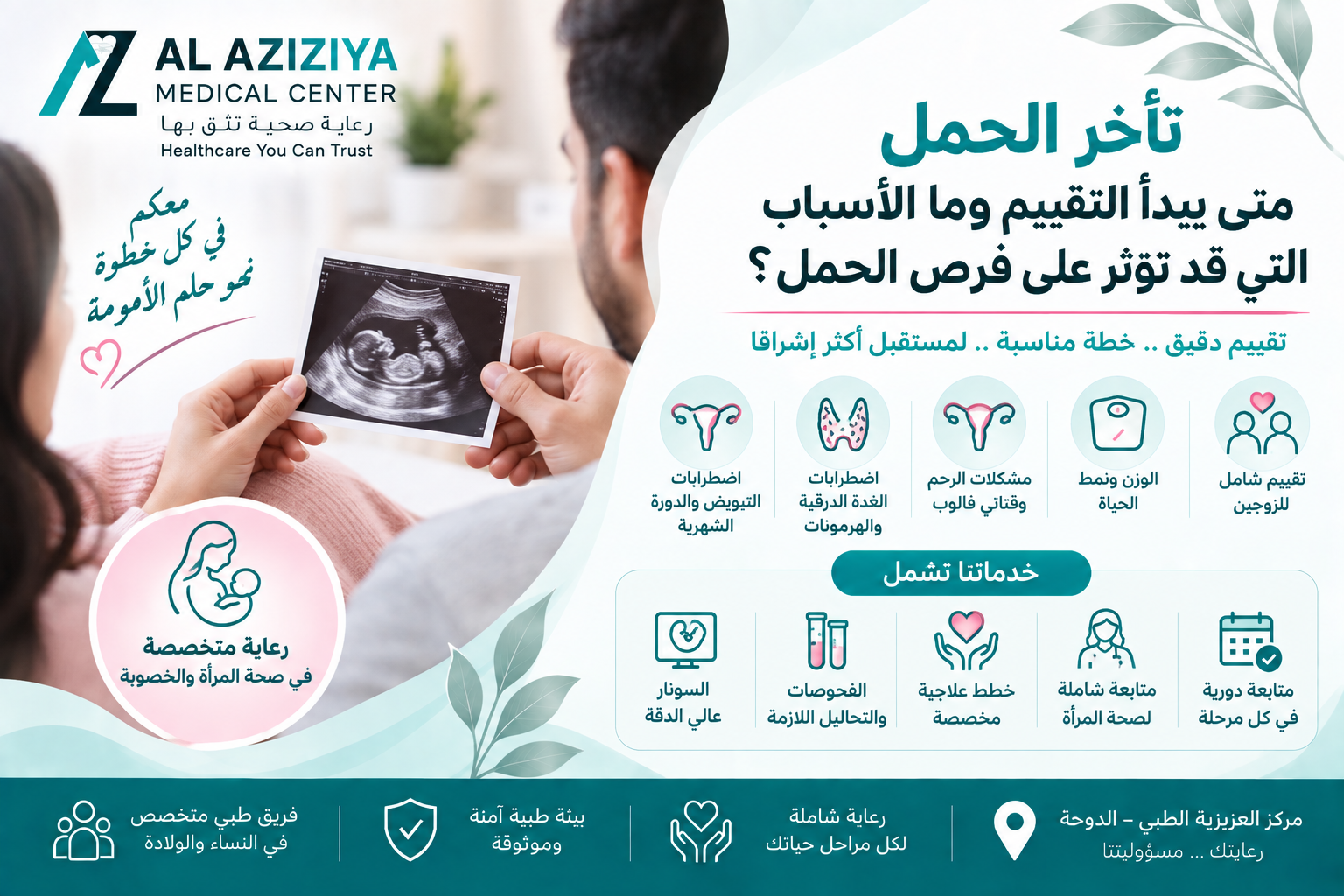
Delayed Pregnancy in Doha: When Should Fertility Evaluation Begin and What Can Affect Conception?
Learn when fertility evaluation should begin, how ovulation, menstrual cycles, PCOS, uterine and tubal factors, age and male factors may affect conception, and how assessment is planned.
Some couples may need time before pregnancy occurs, and this does not automatically mean that a medical problem is present. However, when attempts continue for longer than expected, menstrual cycles are irregular, or a known health condition may affect fertility, medical evaluation can help identify possible contributing factors and guide the next steps.
Delayed conception is best considered as an issue involving both partners. Fertility can be influenced by ovulation, the uterus and fallopian tubes, as well as male factors. A structured evaluation is therefore generally more useful than focusing on one partner or starting treatment without a clear diagnosis.
When Should Fertility Evaluation Begin?
In general, fertility evaluation may begin after 12 months of regular unprotected intercourse without pregnancy when the woman is younger than 35 years.
For women aged 35 years or older, evaluation is generally recommended after about 6 months of unsuccessful attempts. For women over 40, more immediate evaluation may be appropriate depending on the individual situation.
Evaluation should not necessarily be delayed when a condition known to affect fertility is already present, such as significantly irregular or absent menstrual cycles, suspected endometriosis, known uterine or tubal disease, or a known male fertility factor.
Does Delayed Pregnancy Mean Permanent Infertility?
No. Taking longer to conceive does not automatically mean that pregnancy cannot occur.
There are many possible contributing factors, and some can be treated or managed. Some couples may benefit from understanding the fertile window, assessing ovulation, or treating a specific health condition.
The purpose of evaluation is to identify factors that may reduce the chance of pregnancy and select appropriate next steps rather than assuming that complex treatment will always be necessary.
What Can Cause Delayed Conception in Women?
Possible factors include ovulation disorders, irregular menstrual cycles, polycystic ovary syndrome, thyroid disorders, and other hormonal conditions.
Conditions affecting the uterus, fallopian tubes, or endometriosis may also contribute in some patients.
No single symptom identifies the cause, so evaluation may combine medical history, menstrual history, examination, ultrasound, and selected investigations when appropriate.
What Is the Relationship Between Regular Cycles and Ovulation?
Regular menstrual cycles can provide useful information about ovulation in many women, but they do not answer every question related to fertility.
Very infrequent periods, absent periods, or major variation between cycles may indicate a need to assess ovulatory function and possible hormonal causes.
Management should focus on the underlying cause rather than simply changing the timing of menstrual bleeding.
Does PCOS Prevent Pregnancy?
PCOS can interfere with regular ovulation in some women, but having PCOS does not mean that pregnancy is impossible.
The condition varies significantly between individuals. Some women have mild symptoms, while others require follow-up or treatment for ovulation and associated metabolic or hormonal factors.
PCOS alone therefore cannot determine fertility or the appropriate treatment plan without a broader assessment.
Can Thyroid and Hormonal Disorders Affect Fertility?
Some thyroid and hormonal disorders can affect menstrual regularity and ovulation and may be considered when symptoms or medical history suggest that testing is appropriate.
Not every woman requires every available hormonal test. Investigations should be selected according to age, menstrual pattern, symptoms, medical history, and clinical assessment.
How Does Age Affect Fertility?
Age is an important fertility factor because the probability of conception changes gradually as women get older.
For this reason, the recommended waiting period before evaluation is generally shorter from age 35 onward, and even earlier evaluation may be appropriate at older ages.
Age does not by itself determine whether pregnancy can occur, but it is an important consideration when deciding how quickly evaluation should proceed.
Should the Male Partner Also Be Evaluated?
Yes. Fertility assessment should not automatically focus only on the woman because male and female factors can both affect conception.
Parallel evaluation when appropriate can provide a more complete picture and reduce time spent on investigations or treatments that do not address the relevant factors.
The appropriate male evaluation or referral depends on medical and reproductive history and any known risk factors.
How Does Fertility Evaluation Begin?
The first consultation usually includes discussion of how long the couple has been trying to conceive, menstrual cycle regularity, previous pregnancies, medical conditions, previous procedures, medications, and symptoms such as pelvic pain or abnormal bleeding.
Ultrasound may be used to assess the uterus and ovaries, and additional investigations can be selected according to the findings.
A systematic approach helps gather useful information while avoiding unnecessary testing.
What Is the Role of Ultrasound?
Ultrasound can help assess the uterus and ovaries and identify findings such as ovarian cysts, fibroids, or other changes that may need further consideration.
It may also be used in some treatment plans to monitor ovulation. The timing and frequency of ultrasound depend on the clinical situation and the purpose of the examination.
Does Every Woman Need Ovarian Reserve Testing?
Ovarian reserve tests can provide useful information as part of some fertility evaluations, but they are not a single test that can accurately predict whether an individual woman will become pregnant.
Results should be interpreted together with age, reproductive history, and the rest of the fertility assessment rather than used in isolation for major decisions.
Can Weight and Lifestyle Affect Fertility?
General health and lifestyle factors can affect fertility in some individuals, including significant excess or low body weight, smoking, and persistent sleep disruption.
The aim is not to achieve a particular appearance or an identical target weight for everyone. Instead, modifiable health factors can be addressed when they are relevant to the individual's fertility and overall health.
Do You Need to Calculate the Exact Day of Ovulation?
Understanding the fertile period can help with timing intercourse, but fertility is not limited to one exact day.
The fertile window extends across several days around ovulation, and focusing excessively on a single predicted date may create unnecessary pressure.
When cycles are very irregular, app-based predictions may be less reliable, and evaluating the reason for cycle irregularity may be more useful.
When Should Evaluation Begin Earlier?
Earlier fertility assessment may be appropriate when menstrual periods are absent or significantly irregular, when endometriosis is suspected, when uterine or tubal disease is known, or when previous treatments may have affected fertility.
Evaluation should also not be unnecessarily delayed when a male fertility factor is already known or when age and reproductive history indicate that a faster assessment is appropriate.
Why Should Hormonal Tests Not Be Ordered Randomly?
Not every test is useful for every patient, and some hormonal investigations have to be interpreted according to cycle timing and clinical context.
Ordering a large number of tests without a specific clinical question may produce results that are difficult to interpret or do not change management.
The treating physician therefore selects investigations according to medical history, symptoms, examination, and the questions that need to be answered.
Delayed Conception Care at Al Aziziya Medical Center
The Obstetrics & Gynecology Department at Al Aziziya Medical Center in Doha provides women's health and reproductive care including assessment of menstrual disorders, reproductive health concerns, ultrasound, and delayed conception.
The approach begins with assessment of the factors that may affect conception, followed by investigations and next steps selected according to the individual patient rather than applying the same plan to everyone.
Dr. Suzan Saud and Delayed Conception Evaluation
Dr. Suzan Saud, Obstetrics & Gynecology Specialist at Al Aziziya Medical Center, provides women's and reproductive healthcare and has more than 20 years of experience in obstetrics and gynecology.
Her services include evaluation of delayed conception, reproductive healthcare, management of menstrual disorders, and high-resolution ultrasound, with individualized care plans according to each patient's needs.
A structured assessment can help determine whether ovulation monitoring, hormonal testing, uterine and ovarian assessment, or other steps are appropriate.
Early and Structured Assessment Can Save Valuable Time
Delayed conception does not mean that pregnancy is impossible, and not every patient requires complex fertility treatment.
The appropriate starting point is often to identify possible contributing factors in both partners, select useful investigations, and avoid unnecessary testing or treatment.
At Al Aziziya Medical Center in Doha, the Obstetrics & Gynecology Department provides assessment for delayed conception and reproductive health concerns with individualized plans based on age, menstrual history, health history, and patient needs.